George: The Blackletter Font for Monumental Impact
In a world saturated with clean, minimalist sans-serif fonts, there is a powerful allure to the dramatic, the historical, and the bold. For designers, artists, and creators looking to evoke a sense of ancient power, gothic majesty, or medieval craftsmanship, the right typeface is not just a tool—it's a time machine. Enter George, a blackletter display font engineered for one primary purpose: to make a monumental impact. This is not a font for body text or subtle whispers; George is a declaration, a headline, and a crest all in one.
What Exactly Is a Blackletter Font?
Before diving into the specific character of George, it’s helpful to understand its roots. Blackletter, also known as Gothic script, Old English, or Fraktur (in its Germanic variations), is a style of script that originated in the 12th century. It was the dominant form of handwriting in Western Europe for centuries, used for everything from sacred religious texts like the Gutenberg Bible to royal decrees and merchant ledgers.
Characterized by its dense, angular, and ornamental strokes, blackletter is instantly recognizable. It carries an inherent weight and seriousness. In modern design, it has transcended its purely historical origins to become a symbol of:
- Tradition and Heritage: Evoking a sense of deep-rooted history and authenticity.
- Edginess and Rebellion: Famously adopted by heavy metal and punk subcultures for its aggressive, anti-establishment aesthetic.
- Fantasy and Lore: The de facto script for epic fantasy worlds, from book covers to video game interfaces.
- Craftsmanship and Artisan Quality: Suggesting something handmade, detailed, and built to last.
Deconstructing George: More Than Just Old Letters
While many blackletter fonts are direct digitizations of historical manuscripts, George is a modern interpretation designed with contemporary use in mind. Its creator has distilled the essence of gothic calligraphy into a functional, high-impact display typeface. Let's break down its defining characteristics.
Sharp, Rhythmic Strokes
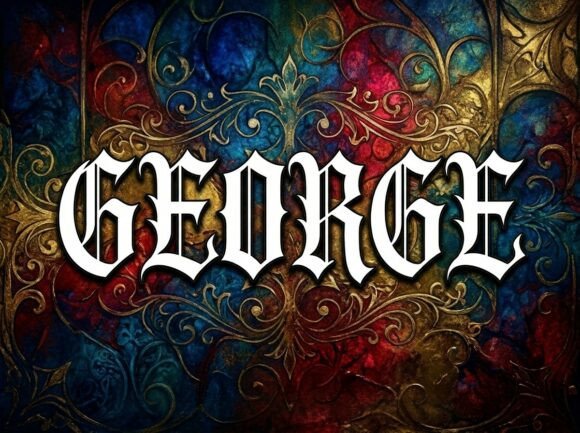
Look closely at the letterforms of George. You’ll notice a distinct rhythm, much like the strokes of a skilled calligrapher’s broad-nibbed pen. The sharp terminals and precise angles give it a crisp, almost metallic quality. This isn’t a soft, faded parchment font; it’s a chiseled, architectural style that feels both ancient and solid. This rhythmic quality ensures that even at a large scale, the letters flow together to create a cohesive and powerful wordmark.
High-Contrast Forms
A key feature of George is its high contrast between the thick and thin parts of each letter. The heavy vertical strokes provide immense visual weight and authority, while the finer, connecting elements prevent the design from becoming an unreadable block. This contrast is what gives George its dynamic energy and ensures legibility, even in complex decorative arrangements.
The Gothic-Manuscript Soul
Despite its modern construction, George retains the "soul" of its origins. It feels like a letterform pulled from an illuminated manuscript or carved into a castle gate. This authentic aesthetic is what sets it apart from overly stylized or cartoonish "gothic" fonts. It respects the historical source material while making it accessible and practical for 21st-century projects.
Where Does George Shine? Real-World Applications
The true value of a typeface like George is realized in its application. Its authoritative weight and historical aesthetic make it a premier choice for specific, high-impact projects. If you're considering using George, here are some of the arenas where it truly excels.
For the Storytellers: Fantasy Novel Titles and World-Building
Imagine the cover of an epic fantasy novel. The title needs to convey a world of swords, sorcery, and ancient kingdoms. George does this effortlessly. Its dramatic presence can anchor a book cover design, instantly communicating the genre to a potential reader. Beyond the cover, it’s perfect for chapter headings, maps, and in-world signage, helping to build a rich, immersive atmosphere.
For the Artisans: Craft Brewery Branding and Distillery Logos
The craft beverage industry thrives on storytelling and authenticity. A brewery or distillery wants to project an image of tradition, quality ingredients, and meticulous process. A logo or label set in George can evoke the feeling of a centuries-old recipe or a family crest. It works exceptionally well for brands with German, Belgian, or British heritage, or for any product aiming for a rustic, handcrafted identity.
For the Visionaries: Heavy Metal Album Art and Band Merch
The connection between blackletter and heavy metal is legendary. The font's aggressive, angular forms mirror the intensity of the music itself. For band logos, album titles, and merchandise like t-shirts and posters, George provides the perfect visual language. It’s a nod to the genre’s roots while offering a clean, professionally designed alternative to often-illegible custom lettering.
For the Creators: Cinematic Dark-Academia Headers
The "dark academia" aesthetic, popular in film, television, and social media, romanticizes classical education, gothic architecture, and a brooding, intellectual atmosphere. George is an ideal fit for this style. It can be used for cinematic title cards, social media headers for bookstagrammers or history enthusiasts, and website designs that aim for a moody, sophisticated, and scholarly vibe.
Is George the Right Font for Your Project? A Practical Guide
Choosing a display font is a critical design decision. While George is incredibly powerful, it’s not a universal solution. Here’s a guide to help you evaluate its suitability for your needs.
Strengths and Best Uses
- Maximum Impact: Use George when you need a headline or logo to grab immediate attention.
- Thematic Clarity: It instantly signals themes of history, fantasy, rebellion, or craftsmanship.
- Pairing Potential: George pairs beautifully with simple, clean serif or sans-serif fonts for body text. A combination like George for headlines and a font like Lato or Merriweather for paragraphs creates a balanced and professional hierarchy.
Considerations and Limitations
- Legibility at Small Sizes: As with all blackletter fonts, George’s intricate details can become muddy or unreadable at very small point sizes. It is a display font, designed for headlines and large-scale use, not for fine print or lengthy body copy.
- Context is Key: Be mindful of the message you’re sending. Using George for a children’s toy brand or a modern tech startup would likely create a confusing and inappropriate brand identity. Its power lies in its specificity.
- Spacing and Kerning: Due to its complex letterforms, you may need to manually adjust the spacing (tracking) and kerning between specific letter pairs to ensure optical balance and perfect legibility, especially in logos.
Conclusion: Embracing a Font with a Story
In the end, George is more than just a collection of digital vectors. It is a typeface with a story, a history, and a distinct personality. It is a tool for creators who are not afraid of drama, who want to evoke a sense of awe, and who understand the power of visual symbolism. Whether you are designing a book cover for the next great fantasy saga, branding a new artisanal product, or creating content that celebrates a gothic aesthetic, George offers a direct line to a world of medieval majesty. It is a testament to the enduring power of blackletter, reimagined for the modern creator.