Lapis Font: Evaluating a Display Typeface for Nautical and Celtic-Inspired Design
Choosing a typeface for a creative project is a decision that goes far beyond simple aesthetics. It involves weighing personality, legibility, technical performance, and thematic alignment. For designers and creators working within specific niches—maritime themes, Celtic mythology, handcrafted goods—the font must carry a significant portion of the narrative burden. Lapis is a display typeface that enters this space with a very specific and heavy illustrative weight. This article provides a practical evaluation of Lapis, helping you determine if its unique characteristics align with your project's goals and requirements.
Understanding the Core Characteristics of Lapis
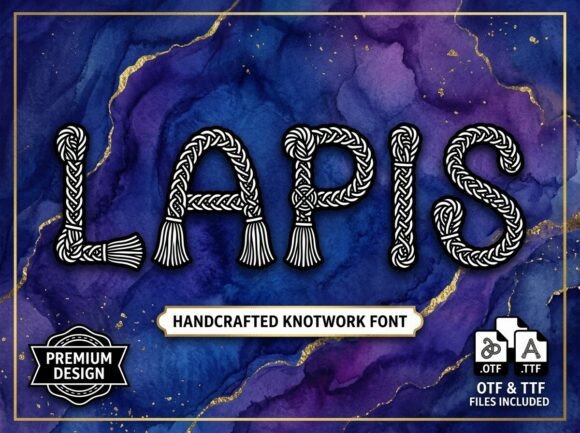
At its heart, Lapis is a masterful display font designed to evoke a traditional, handcrafted, and somewhat tangled aesthetic. Its defining feature is its construction: the letterforms are intricately built from rhythmic, hand-drawn nautical ropes and complex Celtic-inspired knotwork. This is not a subtle texture or a simple outline; the rope and knot motif is integral to the letter's structure, giving it a heavy, illustrative presence. The terminals often conclude with decorative tassels, further enhancing its maritime and artisanal personality. It is a typeface that prioritizes character and thematic expression over neutral readability, positioning itself as a tool for visual storytelling rather than body copy.
Reasons for Considering Lapis in Your Design Work
Interest in a font like Lapis typically stems from a very specific creative need. You might be evaluating it if your project's core concept revolves around the sea, ancient craftsmanship, or mythological narratives. Its aesthetic is immediately evocative, making it a potential candidate for projects where the visual style must communicate a story at a glance. The font's intricate details can add a layer of perceived value and artistry, suggesting that the product or brand it represents is equally detailed and handcrafted. For a designer, the appeal lies in its ability to deliver a strong, pre-built thematic foundation, potentially saving time in developing a visual language from scratch.
Benefits and Practical Considerations
The primary benefit of Lapis is its unparalleled thematic strength. In the right context, it can instantly establish a mood that other fonts would require supporting graphics or layouts to achieve. This can be a significant advantage for branding projects, book covers, or social media headers where impact is critical. However, this strength comes with important tradeoffs. The very complexity that defines Lapis can present challenges in legibility, especially at smaller sizes or in dense text blocks. It is fundamentally a headline or logo font, not a workhorse for paragraphs. Designers must also consider technical aspects like file size, given its detailed vectors, and ensure the licensing aligns with the project's scope, especially for commercial branding or merchandise.
Identifying the Ideal Use Cases for Lapis
Lapis is a strong fit for projects where the design brief explicitly calls for a maritime, Celtic, or mystical macramé aesthetic. Its ideal applications are in high-impact, short-text scenarios. This includes independent nautical branding for a boutique sailing charter or a seaside tavern, where the font can set the tone for the entire identity. It is well-suited for handcrafted jewelry logos, where the knotwork can mirror the intricacy of metalwork or woven pieces. For publishing, it can be effective for mythological book titles or chapter headings, particularly in fantasy or historical fiction genres. Furthermore, its visual density makes it a candidate for social media headers or poster art, where the goal is to capture attention quickly with a strong visual hook.
When to Look for Alternatives to Lapis
There are clear situations where Lapis may not be the optimal choice, and considering alternatives would be prudent. If your project requires high legibility for body text, a simpler serif or sans-serif font is necessary. If the nautical or Celtic theme is meant to be subtle or secondary, Lapis's overt personality might overwhelm the design. For digital interfaces or user experience design, where clarity and speed of recognition are paramount, its complexity could hinder usability. Additionally, if the project has a minimalist, modern, or clean aesthetic, the ornate nature of Lapis will create visual dissonance. In these cases, exploring typefaces with nautical or Celtic hints in a more restrained form, or using Lapis only for a monogram or single initial alongside a cleaner supporting typeface, would be a more balanced approach.
Making a Practical Decision: Key Questions to Ask
To determine if Lapis aligns with your goals, engage in a focused evaluation. First, define the hierarchy of your project. Will this font be used for primary branding, or only for occasional accents? Second, test it at the intended size and in the intended medium. View mockups of the font on a business card, a website banner, and a social media post to assess its real-world legibility and impact. Third, analyze your target audience. Does this aesthetic resonate with their expectations and values? Finally, consider the long-term versatility of your brand or project. A font this distinctive can be powerful but also limiting. Ensure its personality is one you can commit to across various applications for the foreseeable future.
In conclusion, Lapis is a specialized tool for a specific job. It offers a powerful, ready-made aesthetic for nautical, Celtic, and handcrafted themes, best used in display contexts where its intricate details can be appreciated. Its value lies in its ability to communicate a complex idea visually and immediately. The decision to use it should be based on a clear understanding of its strengths—thematic density and illustrative beauty—and its limitations—reduced versatility and potential legibility issues. By evaluating your project's specific needs for personality, audience, and application, you can make an informed choice about whether this masterful display font is the right thread to tie your creative vision together.